Universal Anomaly Photographer
Capture · Corroborate · Discover
The iPhone in your pocket carries more sensors than the instruments that founded whole sciences. UAP Hub aims every one of them at the sky at once — and signs what they saw so nobody has to take your word for it.
The full instrument
One recording session drives the camera, thirteen sensor streams, machine-learning detection, and a cryptographic chain of custody — simultaneously.
4K photo and video with a live telemetry stream riding alongside every frame: GPS with accuracy bounds, attitude quaternions, calibrated magnetometer, barometric pressure, altitude, course, and speed — 62 fields per sample.
Spectral analysis runs through the whole capture: FFT band energies, broadband levels, and anomaly-relevant signatures — timestamped on the audio hardware clock and folded into the evidence record.
High-rate magnetometer sampling runs a 50/60 Hz mains-hum test — the classic "is it just power-line interference?" question — answered from measurement, with the math shown.
CoreML and Vision track objects live in the viewfinder — classification, bounding boxes, and confidence scores computed on the phone, no cloud round-trip.
A spatial radar overlays nearby sighting events on the physical world, so a team in the field shares one picture of where everyone is looking.
A pluggable provider framework brings in what the phone can't do: Bluetooth environmental sensors, MFi/USB-C accessories including FLIR thermal hardware, calibrated light meters — every reading labelled with its true source.
Verified copies to USB-C drives with an F_FULLFSYNC durability barrier and SHA-256 read-back — the receipt states exactly what was verified, and when.
A four-tier throttle ladder trades quality for endurance as battery and thermals demand — capture length beats resolution, and the recording never silently stops. Every step-down is logged as data, not a gap.
Weather, real NOAA geomagnetic K-index, astronomy, and air-data context attach to every observation — each value carrying its source and its observation time.
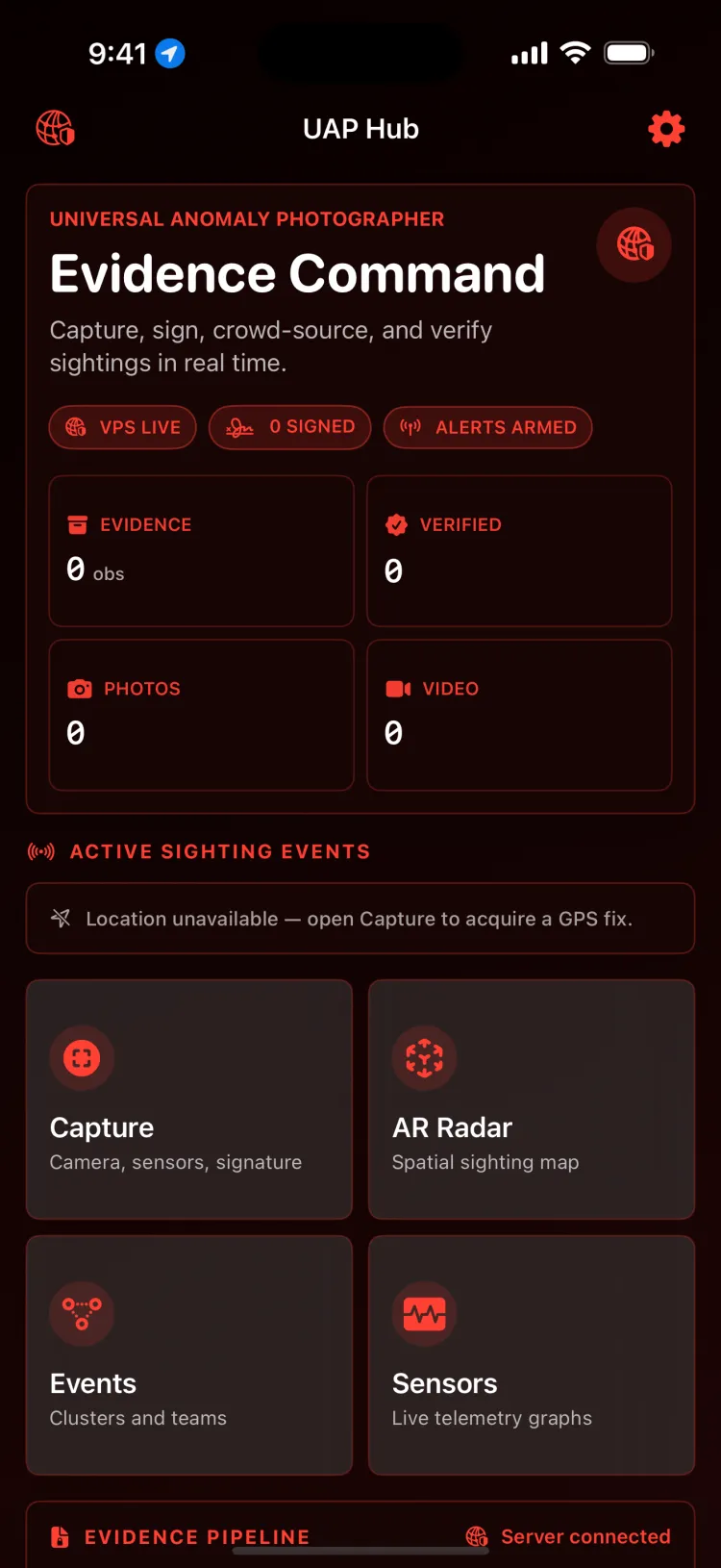
Mission Control
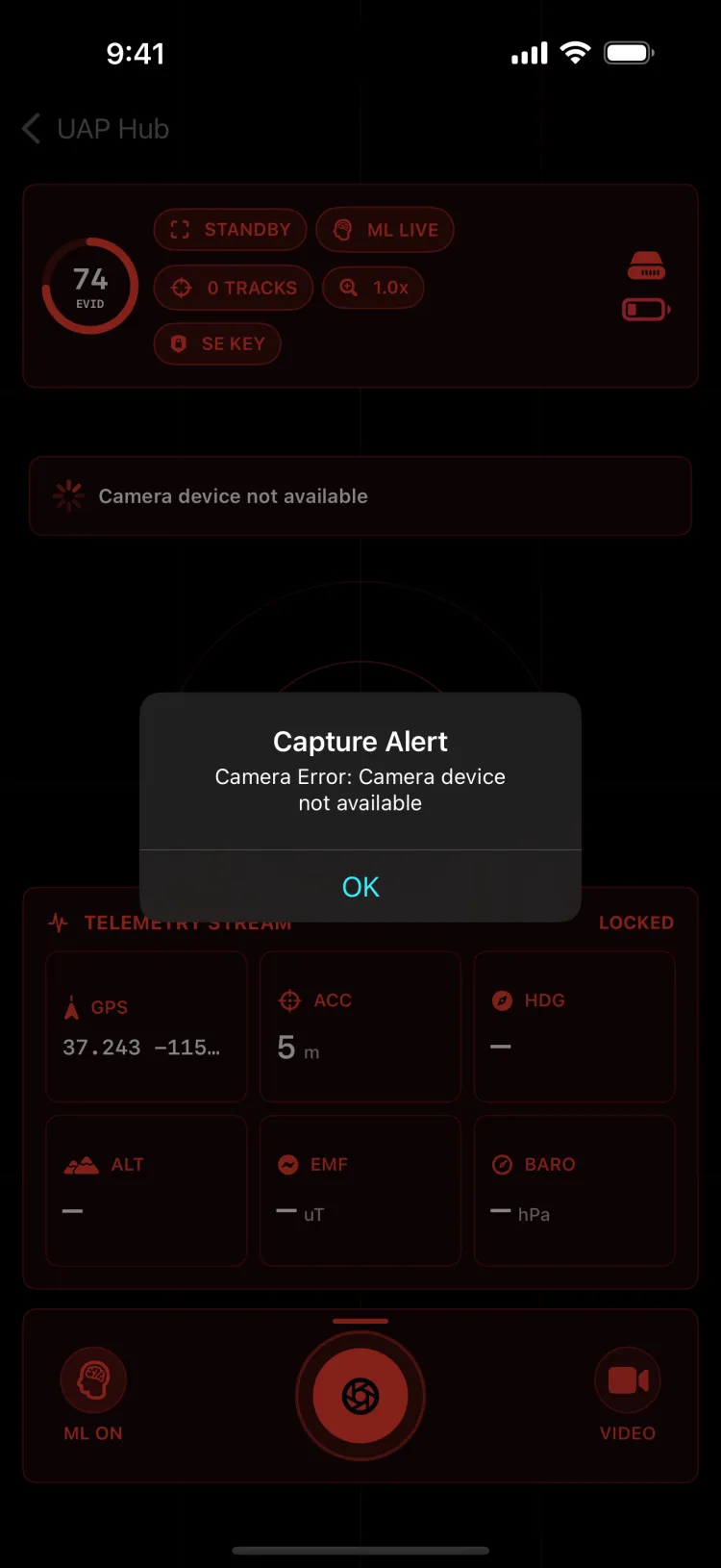
The dashboard tracks your evidence corpus, signature status, live server link, and active sighting events near you. Night-vision mode red-shifts the app's own chrome onto a near-black red ramp — because the moment something appears overhead is exactly the wrong moment to destroy your dark adaptation. iOS still draws its own permission prompts, share sheets, keyboard and maps; everything the app controls goes red.

Capture HUD
The capture screen is a heads-up display: on-device detection state, evidence score, zoom, and a live telemetry strip — GPS fix with accuracy, heading, altitude, EMF, barometric pressure — locked to the session clock while you record.

Chain of Custody
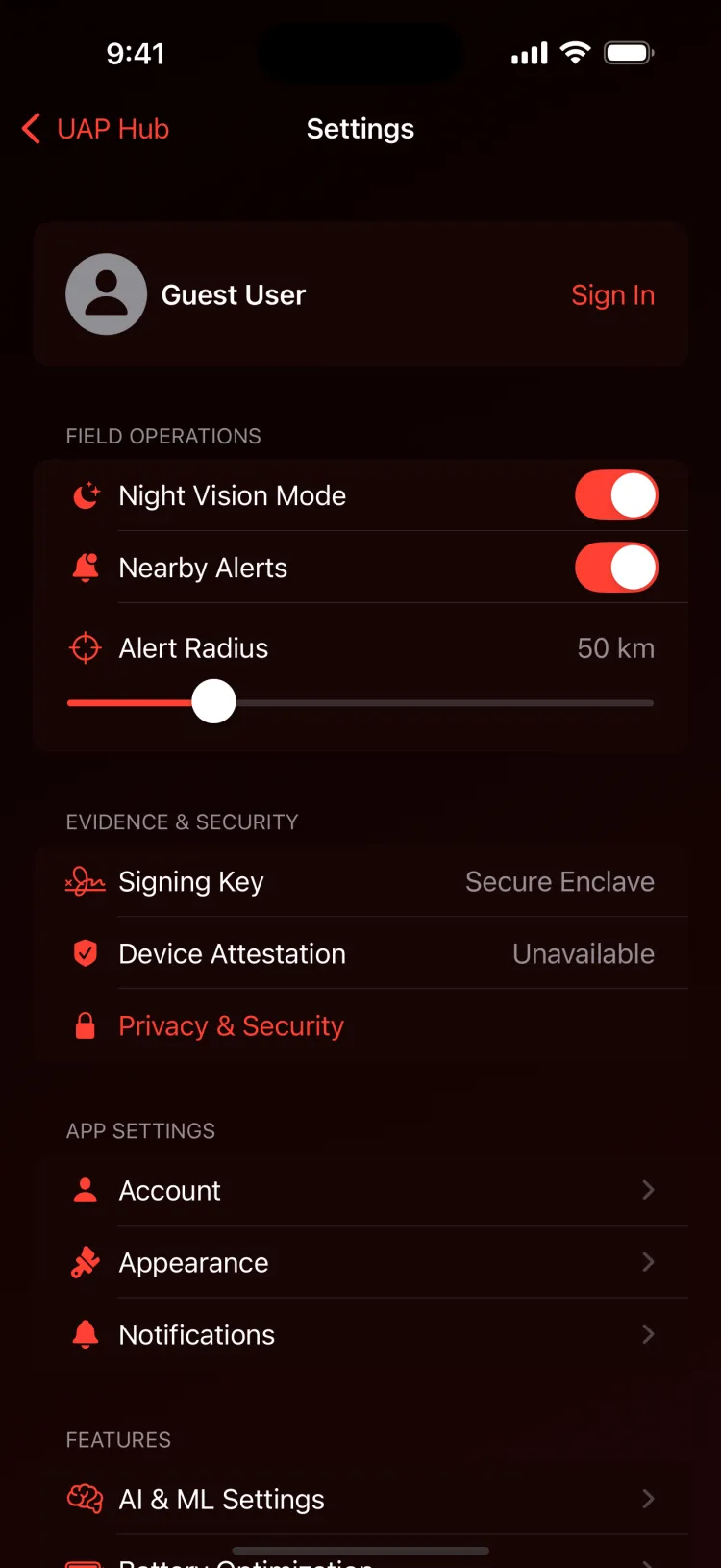
Every observation is signed with a P-256 key that lives in the Secure Enclave — it physically cannot leave the chip. Telemetry is hash-chained into batches, the chain head is embedded in the signed payload, and the server verifies and extends the chain on receipt. Audio, accessory, and optics series get their own signed digests. Tamper with any byte, and the math says so.

Beyond the phone
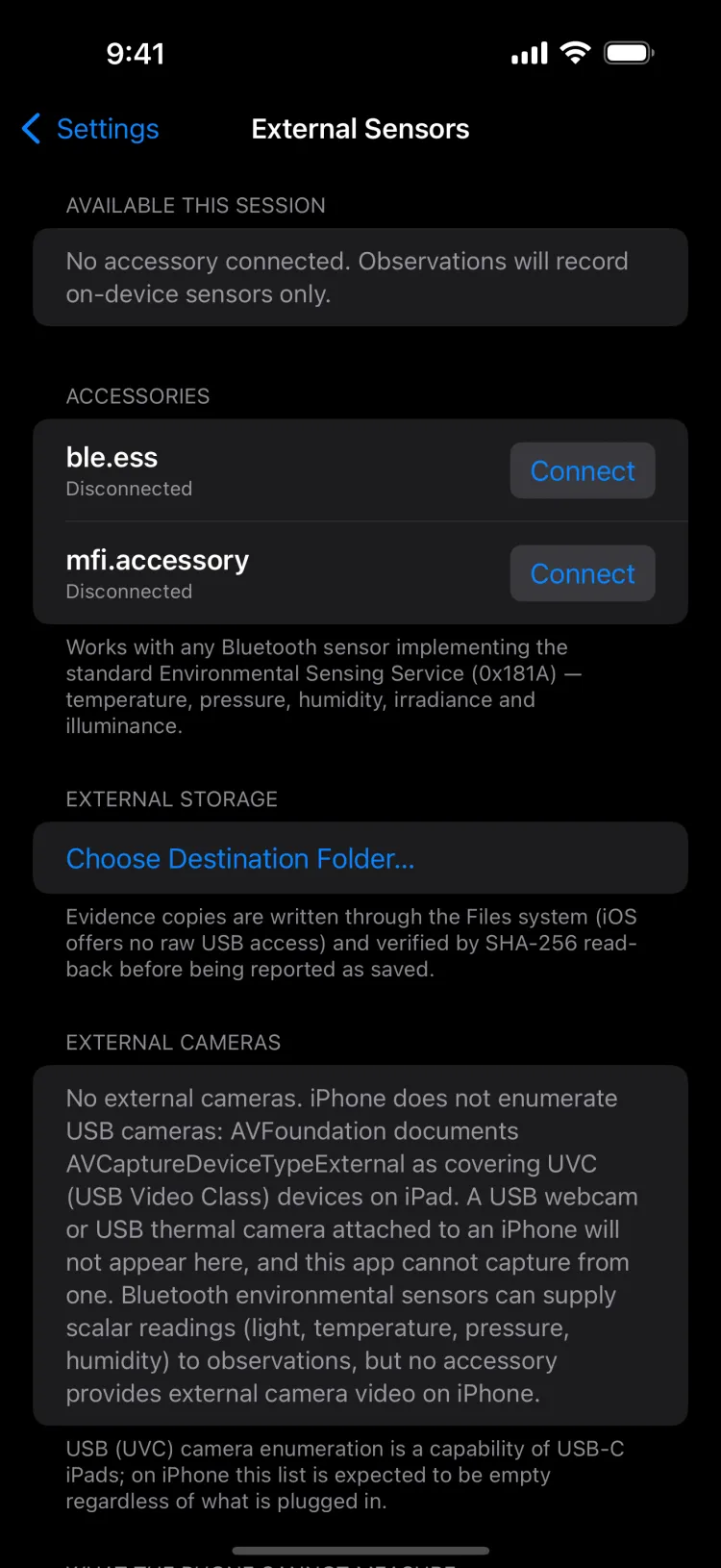
iPhones have no thermal imager, no calibrated photometer, no Geiger counter. UAP Hub treats that as an integration surface, not a dead end: a provider framework ingests Bluetooth Environmental Sensing hardware, MFi/USB-C accessories (FLIR One recognised on attach), and writes verified evidence copies to external storage — every external reading stamped with provider, transport, firmware, and clock-sync status so it can never masquerade as a phone sensor.
Coordinated observation
When a teammate starts recording, everyone's phone erupts with a time-sensitive alert and a compass arrow pointing at the sighting. Multiple simultaneous captures become geometry.
A teammate hits record and the whole team gets a time-sensitive push with a live compass and elevation guide — from phone out to eyes on sky in seconds.
Weighted least-squares intersection of every observer's bearing ray, refined by Gauss-Newton, yielding position, altitude, speed, and trajectory — with covariance and a parallax-derived range bound, not just a dot on a map.
Every solved event is cross-checked against aircraft transponders (ADS-B), astronomy ephemeris, balloon-wind drift, and a parallax-null test before anyone calls it anomalous.
Per-sighting chat channels open automatically; live event rooms stream every observer's position and bearing over SSE while the sighting is in progress.
The honesty contract
Most apps fill gaps with plausible numbers. UAP Hub's codebase is governed by a written rule: no fabricated data, ever. If it wasn't measured, it isn't shown.
A sensor that didn't report shows "—", never a fake reading. Absent values are absent in the signed record too — an unmeasured field hashes as missing, not as a placeholder.
If the magnetometer can't sample fast enough for the mains-hum test, the analysis says so and refuses — it does not report a number it couldn't have measured.
Geomagnetic activity cites NOAA's K-index and observation time. External readings carry their transport and firmware. The UI says "via FLIR One", never implying the phone did it.
The app tells you an iPhone can't enumerate USB cameras, can't do absolute photometry from an auto-exposed sensor, and needs vendor SDKs for thermal frames — before you waste money on the wrong cable.
Under the hood
A native SwiftUI instrument on iOS 18, backed by a lean evidence API — every layer designed around verifiability.